Ethics & Safety Training
Almost nobody who causes harm in this work meant to.
They were a decent facilitator who ended up in a situation they had never imagined, with no framework for it, making a decision in real time. That is how most harm in breathwork actually happens, and it is entirely preventable with training.

The situations you cannot improvise
Every experienced facilitator has a story about the session that went somewhere they were not ready for.
A participant dissociates and does not come back when you call the group in. Someone discloses an assault mid-session. A client mentions a medication, offhand, that changes what is safe to do. One person’s release destabilises an entire room and you have eleven other people to hold. A participant wants to keep going and you can see that they should stop.
None of these are exotic. They happen in ordinary rooms, to well-intentioned people, and the difference between a facilitator who handles them and one who compounds them is almost never good intentions. It is whether they had already thought it through before it happened.
Most breathwork certifications treat ethics as a disclaimer at the end of a module. You are handed powerful physiological tools and a paragraph about scope of practice, and then you are on your own with a real person in front of you.
The framework
Five principles you have already rehearsed before you need them.
These are not values to agree with. They are operational. Each one tells you what to do at a specific decision point, and each one is assessed.
Awareness before action
You assess how this person breathes and where they are before you choose anything. It sounds obvious. It is the step almost everyone skips.
Consent is a conversation, not a form
Consent continues through the session. A signature at intake does not authorize whatever happens forty minutes in, and knowing how to re-check it mid-session is a teachable skill.
Meet the person, not the protocol
Your plan is a hypothesis. When the person contradicts it, they are right and it is wrong. Abandoning a plan in front of a paying client takes practice.
Know your scope
Where breathwork ends and clinical care begins, how to recognize you have reached that line, and exactly how to refer without abandoning someone.
Presence over performance
Dramatic results are not the goal. Chasing them is how facilitators talk themselves past the signals telling them to stop.
Two kinds of protection
They are safe with you on the worst day, not the average one
Contraindication screening before anyone breathes. Recognising dissociation, hyperventilation distress and trauma responses early enough to act. Knowing how to bring someone back, how to close a session that went sideways, and how to follow up afterwards.
Defensible practice, documented
Screening you can show you did. An informed-consent process that holds up. Clear scope boundaries and a referral pathway. Most practitioner exposure comes from working outside scope or failing to screen. Both are training problems before they are legal ones.
Training reduces the situations that create exposure. It is not insurance, and we tell you to carry that too.
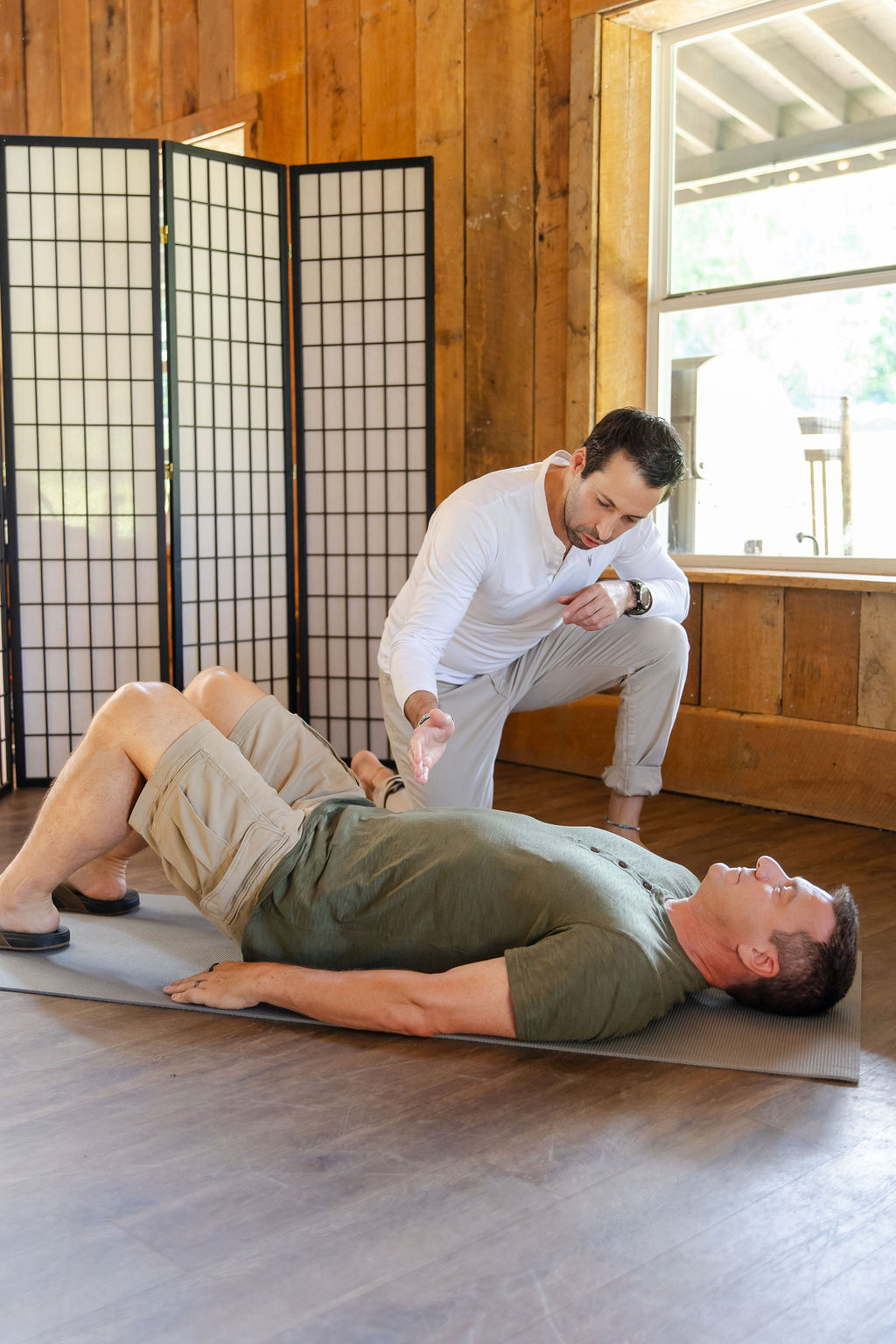
Nobody is certified who has not been observed facilitating
How it is actually taught
This is the part of our program that is furthest ahead of the field.
Not because we care more. Because it is built as training rather than as a warning:
- It is graded. Ethics and scope of practice are assessed modules, not reading. You can fail them.
- Contraindication screening is required to pass. Nobody is certified who cannot demonstrate it.
- You rehearse the hard scenarios in real-world case work and group dialogue, before you meet them with a client.
- You are observed facilitating before certification, by faculty who will tell you what they saw.
- There is a whole book on it. Becoming the Ethical Breathworker exists because no certification our founder took had covered any of this.